

Edeal Homes · For property owners in Dénia
What changes from 1 December 2026, and how we are working to make the transition easier for property owners.
Information reviewed on 18 November 2026
If you own a property in Dénia that you let for days or weeks at a time, the new VAT rules may affect your bookings, invoices and tax returns. Royal Decree-Law 29/2026, ratified on 12 November, introduces 10% VAT from 1 December 2026 for certain short-term rentals. [1] [2]
At Edeal Homes, we are looking at how to organise this transition and make it as straightforward as possible for owners. We want you to understand what changes for your property and have clear arrangements for bookings, invoices and the paperwork involved.
Which rentals will be subject to VAT?
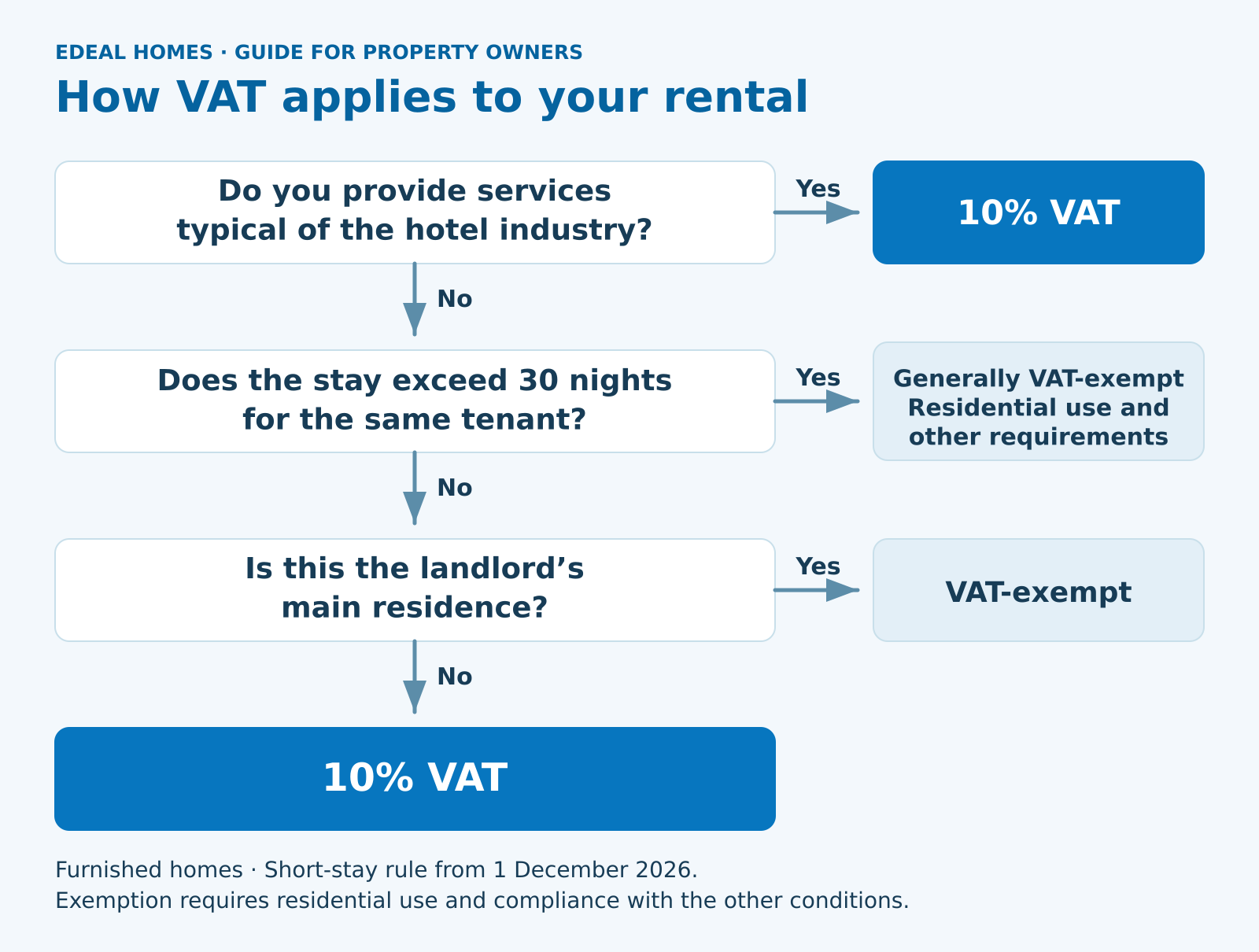
The new rule applies to furnished apartments or homes let to the same tenant for 30 nights or fewer, where the property is not the landlord’s main residence. In these cases, 10% VAT applies even if no hotel-type services are provided. [1]
| Situation | General VAT treatment |
|---|---|
| 30 nights or fewer in a furnished home that is not the landlord’s main residence | 10% VAT |
| More than 30 nights, exclusively for residential use, without hotel-type services | VAT-exempt, if the requirements are met |
| Accommodation with hotel-type services | 10% VAT, including stays of more than 30 nights |
| A short stay in the landlord’s main residence, without hotel-type services | May remain VAT-exempt, if the requirements are met |
Hotel-type services include, for example, regular cleaning or regular changes of bed linen during the stay. Calling an agreement a “monthly rental” does not guarantee exemption: a stay of 30 nights still falls within the new rule. [3]
What about longer temporary rentals?
Rentals of more than 30 nights may remain exempt where the property is used exclusively as a home, no hotel-type services are provided and the legal requirements are met. A stay lasting several months, for example, may be treated differently from a one-week booking.
Length of stay is only part of the assessment. The actual use of the property, the services included and the terms of the agreement also matter. Each type of rental must comply with the rules that apply to it. [3]
What do affected property owners need to prepare?
If your rentals become subject to VAT and are no longer exempt, you will need to organise the following:
- Tax registration or updated details. Review your position using form 036 and notify the tax authority of the relevant obligations.
- Invoices and records. Issue invoices for the affected rentals and retain records of income and expenses.
- Periodic returns. Submit form 303 with the VAT for the reporting period, normally quarterly in these cases. Whether an annual summary is also required must be checked, as some taxpayers are exempt from filing it.
- Correct tax details. Identify the person or entity letting the property and check whose details must appear on the invoices.
VAT obligations also need to be assessed if the owner lives outside Spain. Any obligations relating to tax on rental income continue to apply as appropriate. VAT and tax on rental income are separate matters. [4]
How could VAT affect your rental price?
It is important to distinguish between the price the guest pays and the rent before VAT. These two examples show the difference:
| Pricing decision | Rent before VAT | VAT at 10% | Total paid by the guest |
|---|---|---|---|
| Keep the final price at €1,000 | €909.09 | €90.91 | €1,000 |
| Keep the rent before VAT at €1,000 | €1,000 | €100 | €1,100 |
These figures relate to the accommodation only. To understand the effect on your income, you also need to consider the costs of the rental activity and any VAT you can deduct. The appropriate price will also depend on the property and demand at different times of year. Prices quoted to consumers must include the applicable taxes. [8]
Which VAT can a property owner deduct?
If your rental activity gives you the right to deduct input VAT, you may be able to reclaim VAT on related expenses, such as certain management fees, utilities or repairs. You must have valid invoices and meet the conditions for deduction.
If you combine VAT-taxable rentals with exempt rentals, a proportional deduction, known in Spain as prorrata, may apply. If you also use the property privately, the allocation of expenses to the rental activity must be reviewed. The financial impact therefore needs to be assessed for each owner. [6]
How is the VAT payable calculated?
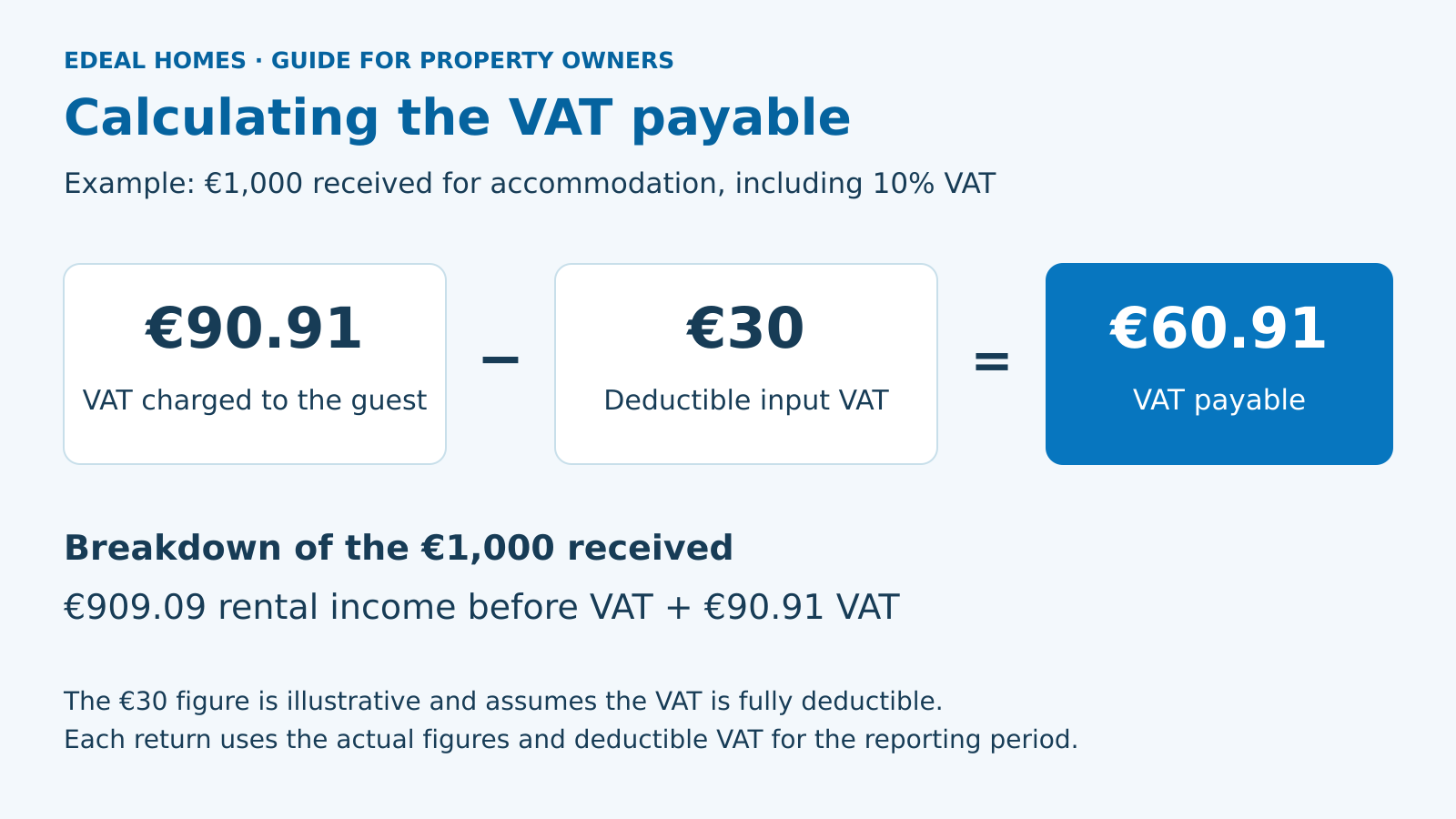
As a general rule, the VAT return records the VAT on your rentals and allows you to deduct eligible input VAT on expenses. The VAT charged to the guest is not always the amount you ultimately pay to the Spanish tax authority. [6]
For example, if you receive €1,000 for accommodation during a reporting period, including 10% VAT, €90.91 of that amount is VAT. If you have €30 of deductible input VAT on expenses, the result in this example would be €60.91 payable. The actual amount depends on the transactions in each reporting period.
What happens to bookings that are already confirmed?
The booking date alone does not determine the VAT treatment. Payment terms and advance payments must be reviewed, particularly where amounts fall before and after 1 December. Before changing the price of a confirmed booking, the agreed terms must also be checked. [7] [8]
How Edeal Homes is working to make the transition easier
At Edeal Homes, we work with owners of holiday and temporary rental properties in Dénia. We know these changes mean additional administration, particularly when a property is let in different ways or the owner lives abroad.
We are assessing the best way to organise this transition, with particular attention to:
- Review which bookings and types of rental are affected.
- Assess how VAT, expenses and pricing fit together for each property.
- Make invoicing and the organisation of paperwork easier.
- Prepare clear statements showing income, taxes and expenses separately.
We are also exploring the possibility of preparing and submitting quarterly VAT returns on behalf of property owners, with the necessary authorisations. We are assessing a service that would allow you to bring these tasks together through Edeal Homes. Once we have defined its scope, how it will work and its terms, we will explain the details clearly.
Our aim is to give you clear information about your property and make the transition as straightforward as possible.
Let’s talk about your rental property
If you own a property in Dénia and want to consider how to manage its rental in light of these changes, tell us about your situation. Let’s discuss your questions and the property management options available through Edeal Homes.
Official sources
- AEAT · Changes introduced by Royal Decree-Law 29/2026
- BOE · Ratification of Royal Decree-Law 29/2026
- AEAT · VAT exemptions for property rentals
- AEAT · Landlords’ VAT returns
- AEAT · Invoicing requirements for rentals
- AEAT · VAT deductions and proportional deduction rules
- AEAT · When VAT becomes due
- BOE · Consumer protection legislation, Article 60
Information reviewed on 18 November 2026. The VAT treatment depends on the actual circumstances of each rental, the services provided and when the tax becomes due. The examples are illustrative.